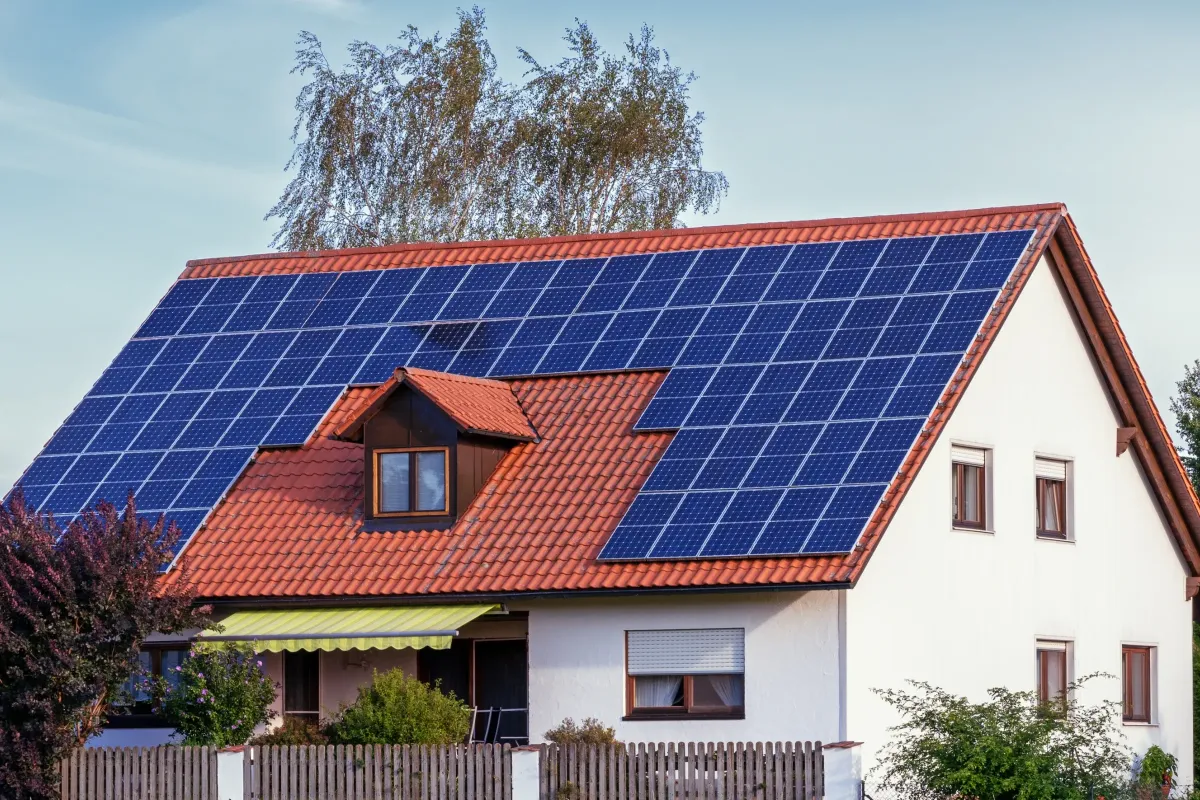
North Solar Panels Guide - Leeds 2026
Got a roof that faces north and wondering if solar's even on the cards? Many Leeds homeowners write off north-facing roofs straight away, but the reality in 2026 is more promising than you'd think. With energy costs still climbing, smarter tech, and strong government support, even north-facing installations can deliver real savings.
Quick Take: North solar panels in Leeds produce roughly 50-70% of what south-facing systems generate, but they can still pay for themselves in around 11-13 years. Modern approaches like tilt frames, split arrays, and high-efficiency panels help bridge the performance gap. Factor in 0% VAT, potential ECO4 grants, and Smart Export Guarantee payments, and many Leeds homes are finding that some solar's definitely better than none.
Table of Contents
What Do We Mean by a "North-Facing" Roof?
Do North-Facing Solar Panels Work in the UK Climate?
Leeds Roof Types Where North-Facing Solar Can Work
Design Tricks to Boost a North-Facing System (Tilt Frames, Split Arrays & Ground Mounts)
Realistic Payback Times: When Do North-Facing Solar Panels Make Financial Sense in Leeds?
North-Facing Solar vs Doing Nothing: Is Some Solar Better Than None?
North-Facing Solar and UK Incentives: 0% VAT, ECO4 and the SEG
What Do We Mean by a "North-Facing" Roof?
A north-facing roof is one whose slope points towards the north away from the sun's path across the southern sky. In the UK, the sun travels in an arc across the south, which means north-facing surfaces receive considerably less direct sunlight throughout the year.
It's the least favourable orientation for solar panels, typically producing only 50-70% of the energy that an identical south-facing system would generate. That's a 30-50% drop in annual output. Shallow north roofs perform better than steep ones because they catch more overhead light.
North-facing doesn't mean non-functioning, though. Your panels will still generate electricity from indirect sunlight, diffuse light on cloudy days, and ambient light. You're working with a sunlight disadvantage, but it's not a complete write-off.
Do North-Facing Solar Panels Work in the UK Climate?
Yes, they work just not as efficiently as other orientations. Britain's often-cloudy skies might seem problematic for north solar panels, but modern technology has changed the game. Solar panels generate power from daylight, including the diffuse light we get on overcast days.
Real-world testing backs this up. An experiment in northeast England found that north-facing panels produced 54% of the energy that equivalent south-facing panels generated. During summer months, when Leeds enjoys long daylight hours, north-facing roofs receive plenty of ambient light.
Modern high-efficiency panels and better inverters have made installations viable that would've been dismissed a decade ago. A north-facing array won't match the performance of other orientations, but if your only roof faces north, these panels can still cut your energy bills considerably.
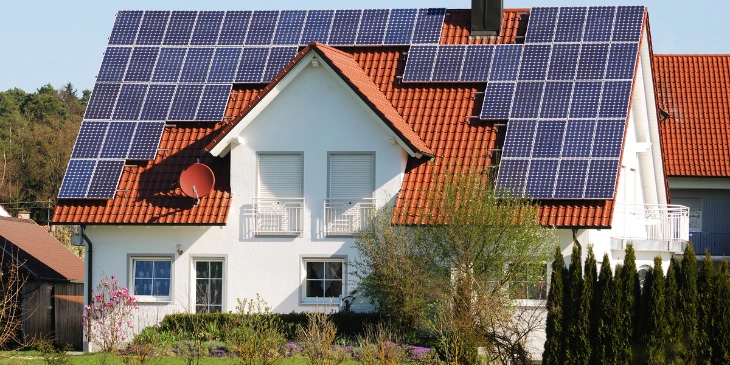
Leeds Roof Types Where North-Facing Solar Can Work
Not all north-facing roofs are created equal. In Leeds' mix of Victorian back-to-backs, post-war semis, and modern developments, certain roof types handle north solar panels better than others.
Shallow-pitched roofs work best. A roof pitched at 15 degrees will outperform one at 45 degrees because it catches more overhead sunlight.
North-west or north-east orientations change the equation significantly. If your roof points north-west, you'll catch direct sun during late afternoon and evening. North-east roofs get morning light. One UK case study found north-west panels still produced about 58% as much energy as south-east panels roughly 220 kWh per panel annually versus 380 kWh.
Dual-pitch roofs offer options. If you have both north and south-facing sections, prioritise the south side first. But once that's filled, adding north solar panels to maximise total generation makes sense.
Flat roof sections on extensions or garages offer flexibility. Panels can be mounted on tilted frames facing south, sidestepping the north-facing limitation entirely.
Professional installers use simulation software to model how your specific roof will perform. It's always worth getting that assessment rather than assuming north means no-go.
Design Tricks to Boost a North-Facing System (Tilt Frames, Split Arrays & Ground Mounts)
If you're stuck with a north-facing roof, several design strategies can help squeeze more performance from your system.
Tilt frames let you mount panels at a steeper angle or tilt them towards the south. One study showed that increasing tilt from 15 to 30 degrees boosted energy output by up to 20%.
Split arrays across multiple roof sections work brilliantly. Rather than putting all panels on the pure north side, distribute them across east, west, and north faces. Combining orientations can outperform a smaller all-south array by generating power over more hours.
High-efficiency panels with microinverters matter more on north-facing installations. Microinverters ensure each panel operates independently at peak output, squeezing out 5-25% more energy compared to conventional string inverter systems.
Ground-mounted arrays are the ultimate solution if your roof won't cooperate. Ground mounts can be angled perfectly for Leeds' latitude typically 30-40 degrees facing due south. They'll produce potentially 20-25% more energy than equivalent roof-mounted capacity.
Realistic Payback Times: When Do North-Facing Solar Panels Make Financial Sense in Leeds?
Will north solar panels actually pay for themselves? A standard 4 kW system facing south in Leeds might produce 3,500-3,800 kWh per year. Face that same system north and you're looking at roughly 2,200-2,600 kWh annually.
Here's how payback typically works:
A south-facing 4 kW system might save around £800-£900 yearly, paying itself back in roughly 7 years
A north-facing 4 kW system might save about £500 per year and take closer to 11-13 years to pay off
Expect around a decade or slightly more for north solar panels in Leeds to break even. A 12-year payback on panels lasting 25+ years means over a decade of essentially free electricity afterwards. The cost works out to only about 12 pence per kWh over its lifetime well below the roughly 30p/kWh you're paying the utility in 2026.
A typical 4 kW domestic installation in Leeds runs about £6,000-£7,000 including the current 0% VAT. If payback is significantly shorter than panel lifetime and you're not planning to move soon, the investment is worthwhile. Rising energy prices have changed the equation with electricity at 30p/kWh or more, even modest solar generation yields substantial savings.
North-Facing Solar vs Doing Nothing: Is Some Solar Better Than None?
If your only available roof faces north, you might wonder whether solar's worth bothering with. In 2026, the answer is clear: in most cases, some solar beats none as long as the system's properly designed.
Even north solar panels will generate substantial energy over the year, reducing grid reliance and cutting both bills and carbon emissions. Once your panels are paid off, that energy's essentially free. By contrast, doing nothing means continuing to buy 100% of your electricity from the grid at high prices.
Solar technology improvements and soaring electricity costs have shifted the equation. One north-facing array in a UK study provided 35% of a home's total solar energy over the year when paired with south panels.
However, if a north-facing system's output is extremely low your roof is steep, shaded, and small payback might stretch beyond being worthwhile. Get a realistic forecast of kWh output and savings. If projection shows payback beyond 20-25 years, alternatives might be better.
The verdict: Some solar's usually better than none if the system can pay for itself and you value the environmental benefit. North solar panels still produce clean electricity that saves money and CO₂.
North-Facing Solar and UK Incentives: 0% VAT, ECO4 and the SEG
Several UK incentives improve the economics of solar installations, applying to north-facing systems just as much as any other orientation.
0% VAT on Solar Panels
Since April 2022, the UK has made home solar installations VAT-free for five years. You don't pay any VAT on equipment or installation. On a £6,000 system in Leeds, 5% VAT would've been £300, that's £300 saved. When you get quotes from Leeds installers, they should already reflect zero VAT.
ECO4 Scheme (Solar Panel Grants)
The Energy Company Obligation phase 4 (ECO4) is a government-backed programme aimed at low-income households. ECO4 can fund solar installations at little to no cost to you.
If you receive certain benefits or have household income below a threshold (and your home has a low energy efficiency rating), you might be eligible for free or heavily subsidised panels. This is game-changing if you have a north-facing roof because it removes the financial risk.
Smart Export Guarantee (SEG)
The SEG ensures you get paid for any surplus solar energy you export to the grid. You arrange with an energy supplier to receive a tariff for each kWh your system exports.
Rates typically range from around 4-5 pence per kWh up to roughly 15 pence per kWh for the best offers as of 2026. Some suppliers offer higher rates at certain times.
SEG is important for north solar panels because even at lower production rates, you won't waste that energy. Over a year, those export earnings contribute to your system's payback. Also consider self-consuming more solar via battery storage, since avoided purchase at 30p is more valuable than export at 5-15p.
The bottom line: The UK has made it easier and more profitable to go solar. You save upfront with zero VAT, might pay nothing with ECO4 if you qualify, and earn bill credits plus cash for excess energy through SEG.
Final Thoughts on North-Facing Solar Panels
North solar panels in Leeds aren't the ideal choice, but they're far from useless. In 2026, the combination of higher energy prices, better technology, and solid government support has made north-facing installations viable for many homeowners.
You're looking at roughly 50-70% of the output you'd get from a south-facing system, which translates to longer payback times typically 11-13 years rather than 7. But with panels lasting 25+ years, that still represents a solid long-term investment.
Leeds homeowners with north-facing roofs have options. Whether it's using tilt frames, splitting arrays, employing high-efficiency panels with microinverters, or considering ground mounts there are ways to make it work. This is about leading the way with what you've got, the Leeds way.
For areas across Leeds whether you're in the City Centre, North Leeds, South Leeds, East Leeds, or West Leeds the principles remain the same. North-facing doesn't mean impossible; it just means you need to be smarter about design.
Consider the full package: 0% VAT, potential ECO4 grants, and SEG payments. Factor in maintenance needs to keep your system running at peak performance. And remember that even reduced solar generation is still clean energy that cuts your bills and carbon footprint.
If you're a Leeds homeowner weighing up whether north solar panels make sense, get in touch for a professional assessment. We're here to help you take the lead on energy, savings, and sustainability because that's how Leeds does solar.
North-Facing Solar Panels FAQs
Can you put solar panels on a north-facing roof in the UK?
Yes, you can install solar panels on north-facing roofs in the UK. Whilst they'll produce 30-50% less energy than south-facing panels, they still generate worthwhile electricity from ambient and diffuse light. Modern technology and higher energy prices have made north-facing installations financially viable for many Leeds homeowners.
How much less efficient are north-facing solar panels?
North-facing solar panels typically produce 50-70% of the energy that identical south-facing systems generate. The exact figure depends on your roof pitch, local climate, and whether your roof faces true north or slightly north-east/north-west.
Are north-facing solar panels worth it financially?
In most Leeds cases, yes. North solar panels usually pay for themselves in 11-13 years compared to 7 years for south-facing systems. With panels lasting 25+ years and current electricity prices around 30p/kWh, you'll still see over a decade of essentially free power after breaking even.
What's the best way to improve north-facing solar panel performance?
The most effective strategies include using tilt frames to angle panels towards the sun, splitting your array across multiple roof orientations, installing high-efficiency panels with microinverters, and considering ground-mounted systems if you have available space.
Do I qualify for grants or incentives for north-facing solar panels?
Yes, the same incentives apply regardless of orientation. All domestic solar installations benefit from 0% VAT until March 2027. If you're on certain benefits or have low household income, you might qualify for ECO4 grants. The Smart Export Guarantee also pays you for excess energy exported to the grid.
Should I add battery storage to north-facing solar panels?
Battery storage can make sense for north-facing systems, especially if you want to maximise the value of every kWh generated. Since north panels produce less overall, storing that energy for evening use helps improve your return on investment. Battery storage also qualifies for 0% VAT when installed with solar.